
The struggle to gain traction on professional networks is real. You spend hours crafting a post, only to be met with total silence. No likes, no comments, and zero leads. This is the common reality for many companies today.
For many companies, the problem starts with how they show up online. Their corporate accounts function like digital billboards in a deserted town. They broadcast messages but never build connections. This approach fails because it lacks a clear social selling strategy. To change the results, you must first understand the shift in how people consume content.
Here’s what’s happening.
1. The Math of Getting Ignored
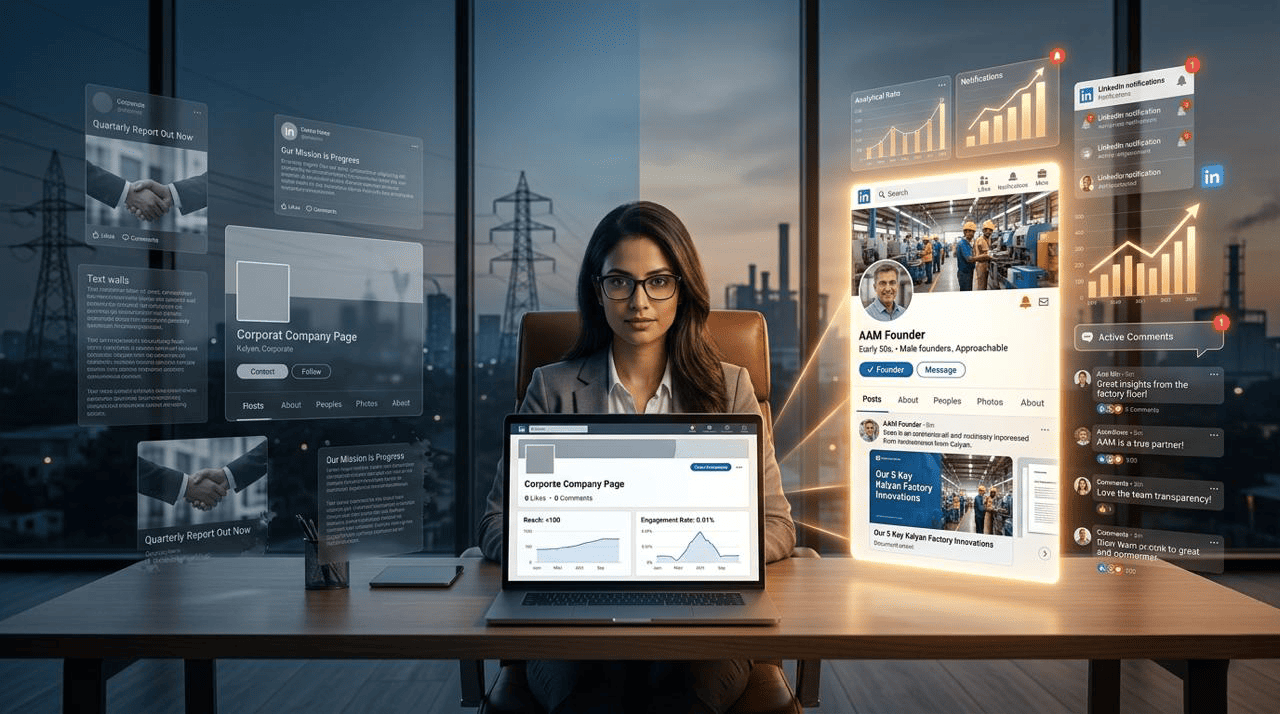
The primary reason why B2B brands fail on LinkedIn is a heavy reliance on corporate pages. These pages were once powerful, but the landscape has changed. According to the Digital Applied 2026 B2B Marketing Report, personal profiles now generate 8x more engagement and 5.6x more organic reach than brand pages.
When you hide behind a logo, you lose the human element that drives trust. Relying solely on company page reach is like trying to start a fire with damp wood. The friction exists, but the spark remains missing.
2. The New Metric of Success: Dwell Time
In the current era of the LinkedIn Algorithm 2026, vanity metrics have lost their value. The platform does not just care if someone clicks a button; it cares if they actually stay to read. This is measured through Dwell Time.
A study by Prominence Global 2026 Algorithm Analysis reveals a staggering gap in performance based on attention. Posts that hold a user for 61 seconds or more enjoy a 15.6% engagement rate: while those skimmed in under 3 seconds settle for a meager 1.2%.
If your content is just a wall of text or generic jargon, people scroll past in an instant.
3. Humanizing the Industrial Machine
Simplifying the complex is the secret to staying relevant. Many brands fail because they think technical specs are the only way to show authority. In reality, industrial content marketing should focus on the people solving the problems. You need to move from “what we sell” to “who we help.” A great way to do this is through digital storytelling for B2B.
To fix the disconnect, consider these shifts in your posting habit:
- Swap the Manual for the Mission: Instead of showing a product manual, show the mess on the factory floor before a breakthrough.
- Stay Native to the Feed: Avoid the urge to drive traffic away from the platform too quickly. Using external links in your main post often leads to a massive penalty in reach.
- Deliver Value Upfront: The algorithm wants to keep users on the site: so provide the answer right there in the post.
- Visual Authenticity: Stop using stock photos of handshakes; use real photos of your team or your process.
- The Power of the Face Behind the Brand
Founders and leaders are the new brand ambassadors. People connect with individuals who share their journey, mistakes, and wins. This is the core of founder-led branding. It is much easier to trust a person than a faceless entity. To make this work, use formats that encourage exploration.
Cleverly 2026 LinkedIn Benchmarks show that document carousels achieve a 6.6% average engagement rate. This is significantly higher than standard text posts. By sharing your expertise through a human lens, you naturally improve your B2B brand recall.
The New Benchmark for Success
Success on this platform is not about being the loudest. It is about being the most helpful. You must move away from the “broadcast” mindset. When you stop treating the feed like a repository for press releases, you start building a community.
Remember that why B2B brands fail on LinkedIn often comes down to a lack of perspective on what the reader actually needs. If you focus on providing depth, staying native to the platform, and leading with a human face, the algorithm will reward you. Focus on the person on the other side of the screen. Because that is where the real growth begins.